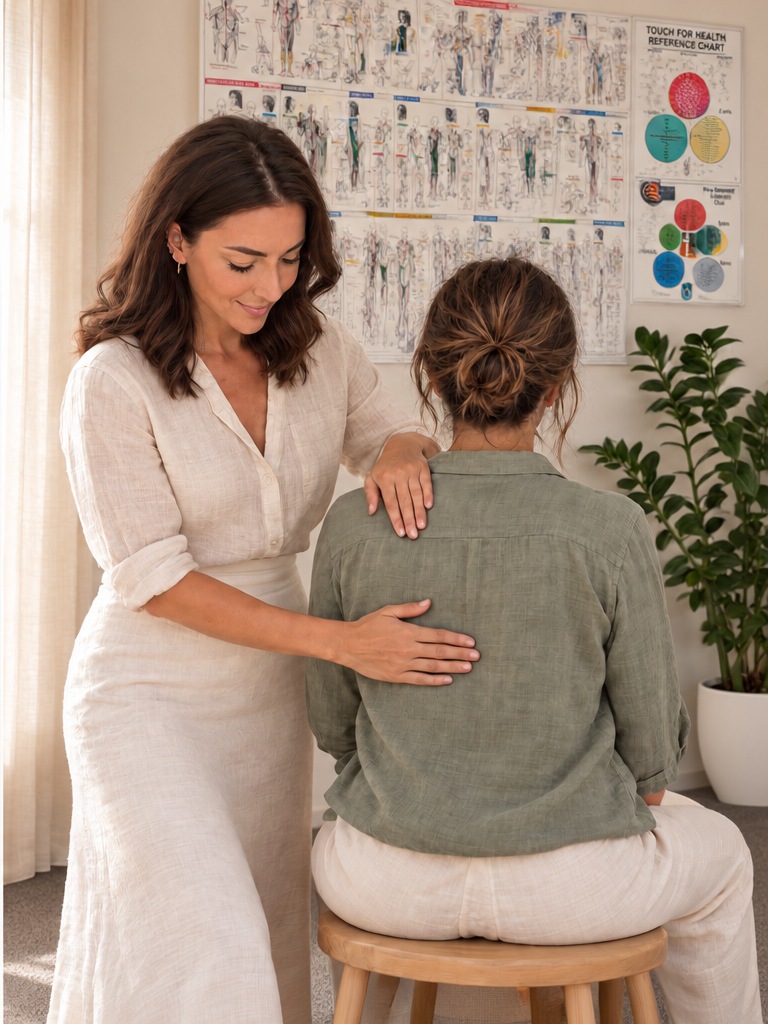
When your body feels tense, unsettled or depleted, it can be hard to feel like yourself. Sessions bring the focus back to your physical experience, with kinesiology and gentle, agreed body-based practices.
LISTENING THROUGH THE BODY
A little conversation. A hands-on approach.
You can begin with a simple description of how you feel.
I ask about your goals and relevant health information, then introduce gentle muscle monitoring. Most of the session can focus on the practical work: comfortable positioning, light contact and noticing your response.
“Listening to the body” describes the attention I give to changes in muscle response, movement and how you feel. Your own observations remain central; you do not need to find words for every sensation.
UNDERSTAND THE APPROACH
What does kinesiology involve?
Kinesiology brings gentle muscle monitoring and balancing practices into a session focused on your whole-person wellbeing.
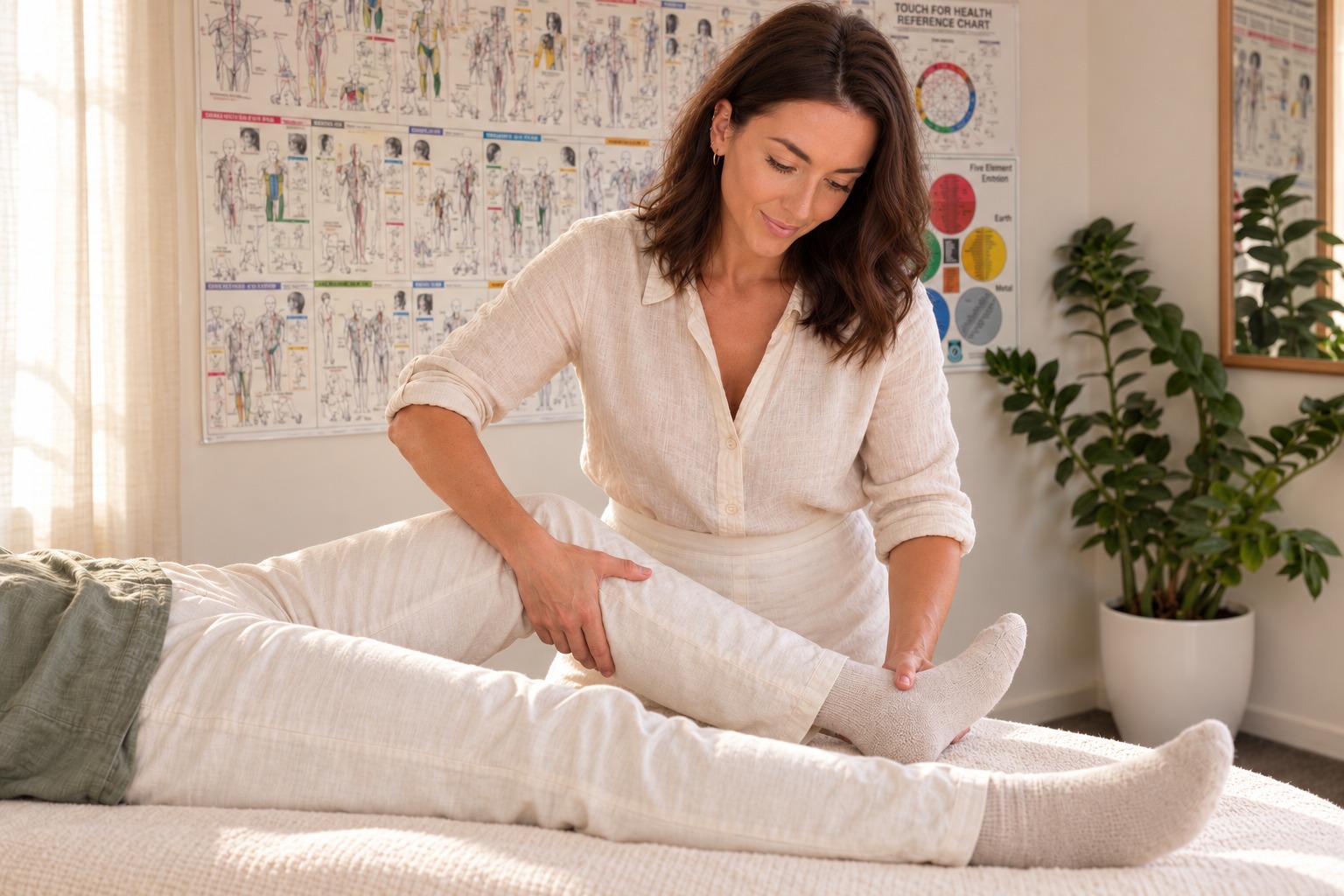
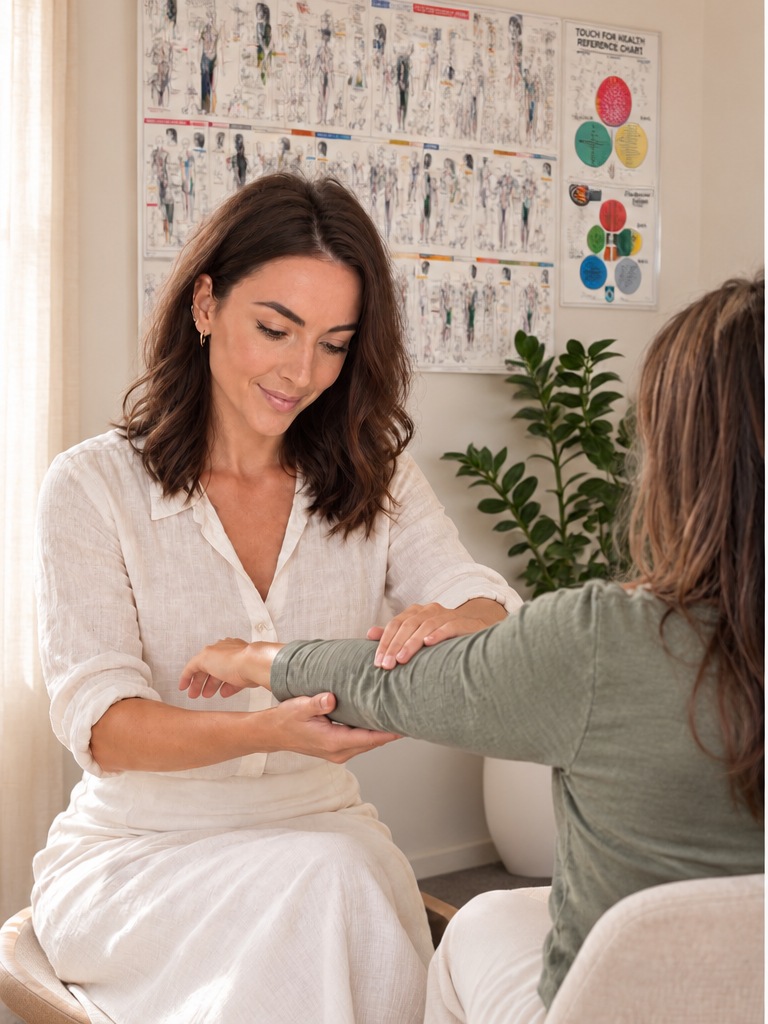
I position an arm or leg comfortably and apply light, brief pressure while you hold its position. I notice whether the muscle maintains that position or yields. This is a cooperative check, rather than a test of strength. Position, effort and comfort can all affect the response.
Within Touch for Health and Soul Power, these responses help guide the sequence of balancing techniques. I check again afterwards and invite you to notice any change in comfort, movement or how you feel. Your feedback and consent guide each next step.
Touch for Health combines muscle monitoring with a system of touch and movement practices, drawing on traditional acupuncture-meridian concepts. A balance may involve several muscles and associated points, rather than concentrating only on the area where tension is noticed.
I draw on Levels I and II, including gentle point contact, meridian tracing and muscle-related balancing techniques. I explain the proposed technique and adapt the contact to your comfort.
Soul Power is a combination of kinesiology, colour and energy-based practices, bringing physical, emotional, mental and spiritual wellbeing into one framework.
I draw on Levels 1–6 and foundational Colour for Life. Alongside arm and leg muscle monitoring, a session may include colour selection, gentle holding points, grounding or practices based on meridian and chakra traditions. Colour can offer a starting point for personal reflection; energy work follows the modality’s spiritual framework.
I explain the options so you can choose what feels meaningful. You are welcome to focus on the physical work, or include colour and energy-based elements.
I bring the approaches together around your goals, the muscle responses I observe and your feedback. There is no need to select a modality before you arrive. I explain each option and help you explore a combination that feels comfortable and relevant.
THE TRIANGLE OF HEALTH
Three sides. One whole person.
The Touch for Health manual uses a triangle to represent structural, biochemical and mental/emotional aspects of wellbeing. Its equal sides symbolise giving each area attention, recognising that a change in one part of life can affect the others.
I use this as a whole-person teaching model, rather than a measurement or a requirement to achieve perfect balance. The aim is to consider all three sides and explore where support feels most useful for you.
Hover over a side or heading, or select a heading, to explore. On a keyboard, use Tab to move between headings.
Structural / physical
Your physical experience: posture, movement, muscle response and comfort. This is the hands-on side of the model, explored through gentle monitoring and balancing practices.
IN PRACTICE
Gentle contact. Attention to your body.
From muscle monitoring to comfortable positioning, each part of the session is explained and agreed with you.
THE HANDS-ON WORK
Small points of contact. A considered sequence.
These are techniques taught within Touch for Health. I select and explain them within the scope of my training, using pressure and positioning that feel comfortable for you.
EXPLORE THE CONTACT
Four ways of working.
Still contact
A gentle hold
The concentric circles represent a steady point of contact, not a location on the body. Neurovascular points differ according to the muscle or balancing sequence.
I explain the contact and check your comfort before beginning.
Local contact
A small, focused movement
The circular arrow represents contact around a selected reflex point. The particular points depend on the muscle being monitored; this is not a lymphatic drainage map.
I explain the contact and check your comfort before beginning.
Tracing a pathway
A continuous line of attention
The line and dots show the idea of a pathway and selected points. This is a conceptual illustration, not a named meridian route. Meridian pathways belong to the traditional Chinese medicine framework.
I explain the contact and check your comfort before beginning.
Two attachment sites
Where a muscle connects
The central shape represents a muscle between two attachment sites. It illustrates the relationship only: the locations and contact vary with the muscle involved.
I explain the contact and check your comfort before beginning.
Looking for detailed point-location diagrams?
These original illustrations introduce the kinds of contact rather than teach point locations. For detailed muscle-specific charts, explore Touch for Health Animated Reference or eTouch’s interactive chart guide. In a session, I can explain the relevant reference alongside the practical work.
◌
Neurovascular holding points
Light contact on specific points, commonly on the head, forms part of the balancing sequence. In the Touch for Health model these are associated with vascular reflexes; in a session, you experience a gentle, still hold.
⁙
Neurolymphatic reflex points
These points are contacted or gently rubbed according to the muscle being monitored. Their name comes from the method’s proposed lymphatic associations. This is distinct from clinical manual lymphatic drainage.
∿
Meridian pathways & points
Meridians are the traditional Chinese medicine concept of energy pathways. I may trace a pathway with my hand or contact selected points as part of a Touch for Health balance. No needles are used.
↔
Origin–insertion contact
A muscle’s origin and insertion are its attachment sites. This technique uses brief, local contact near those attachments, followed by another gentle muscle check and attention to how the movement feels.
BEYOND WORDS
Space to notice. Time to respond.
You might notice a change in how a movement feels, a deeper breath or simply the experience of pausing. I invite you to share as much or as little as feels helpful while I guide the practical work.
A session begins with a brief check-in, then moves into muscle monitoring and agreed balancing techniques. I return to your original focus at the end, so you can reflect on your experience.
WHAT HAPPENS IN A SESSION
Notice. Explore. Review.
Notice
Share your starting point.
I begin with a brief check-in about your goals, relevant health information and comfort, then introduce the practical work.
Explore
Work with the body.
I use gentle muscle monitoring and agreed balancing techniques, noticing responses and checking your comfort throughout.
Review
Listen to your experience.
Notice how you feel afterwards and consider simple next steps. Further sessions are your choice.
Clinic sessions in Rodney & the North Shore. Mobile sessions available by arrangement. Confirmed addresses, contact details and booking availability will be supplied before appointments open.